
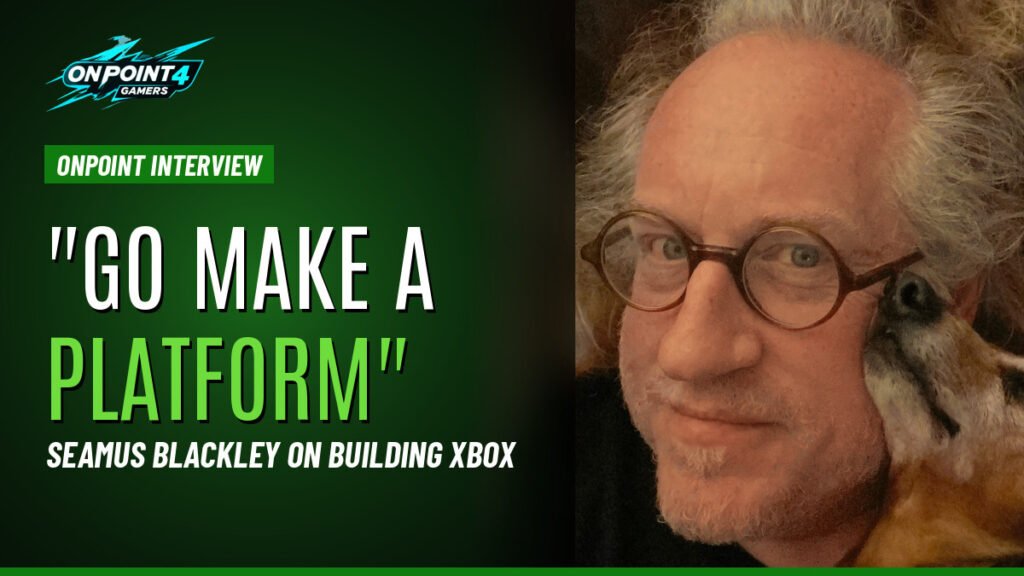
Ahead of Xbox's 25th anniversary on Nov 15, we're bringing our sit-down with the man the community calls the Father of Xbox to the page: the $5 billion pitch, the fights to keep the hard drive and the network port, Halo saving the day, and the marker that made Xbox green.
Every Xbox story starts somewhere, and this one starts with a physicist on a plane. Before Seamus Blackley pitched Microsoft on a console, he studied physics at Tufts, worked on high energy physics at Fermilab, helped build the flight model for Looking Glass’s Flight Unlimited, and produced the famously ambitious Jurassic Park: Trespasser at DreamWorks Interactive. He joined Microsoft in February 1999 to work on DirectX, and by March 2000 the console he dreamed up was on stage at the Game Developers Conference. On Nov 15, 2001, it launched in North America with Halo: Combat Evolved by its side.
Xbox turns 25 on Nov 15, 2026. Before the celebrations kick off, we went back to one of the biggest conversations we’ve ever had on the channel, and honestly, there’s no better way to warm up for the birthday. Doodle and I sat down live with Seamus Blackley, one of the creators of the original Xbox. He talked for about an hour and a half about how a frustrated new Microsoft hire pitched a console nobody inside the company wanted, what he had to fight for, and what he thinks keeps this industry alive. Real talk: if you love Xbox, this is the origin story straight from the source.
Answers below are lightly edited for length and readability.

What you need to know
- Who: Seamus Blackley, co-creator of the original Xbox.
- Where: the OnPoint 4 Gamers YouTube channel, hosted by CMoney and Doodle.
- Length: 1:31:07 (streamed live, 2024).
- Highlights: the Xbox origin story, the “coffin box” years, the hard drive and Ethernet port fights, Halo, why Xbox is green, and his advice on failure.
How did you get into video games?
Seamus Blackley: “Back when I was a kid, there wasn’t a video game industry. If you wanted to play video games, you needed to cause a video game to happen… It was really clear to me that the best and only legitimate use for a computer was to play games.”
“If you don’t like the platforms and options available to you for playing games, go make a damn platform. I mean, what’s stopping you?”
Pitching a console that would lose money
Context: in the late 1990s, Microsoft made its money on Windows and Office. A games console meant selling hardware at a loss for years.
Seamus Blackley: “I remember a Microsoft-wide P&L meeting with all of the heads of the business divisions, and Bill Gates and Ballmer… I was sitting next to this guy who at that time ran Microsoft Office, and at that time Microsoft Office was the most profitable business in the history of the human race, with no exaggeration. And then I had to go and talk about the $5 billion we were going to lose before having any chance of even making $1 in profit. So that was uncomfortable.”
How a failed game led to Microsoft
Context: Trespasser, the Jurassic Park game Seamus produced at DreamWorks Interactive, shipped in 1998 after a troubled development and became infamous. He has always taken responsibility for it.
Seamus Blackley: “I met Bill Gates because he was an investor in DreamWorks, and I had this failed game called Trespasser at DreamWorks with Steven Spielberg… I remembered Bill had been really impressed by [the Trespasser build] that we showed him, and he said you should come work for Microsoft. So I had his email address, so I emailed the guy and he forwarded it to somebody in HR. Then I went and had interviews and got a job.”
On staying in the room once you’re there: “The trick was hanging in that room by actually being valuable and actually producing something, and actually having ideas that were exciting, and then going off and actually getting them done.”
Failure and the “legend” label
Seamus Blackley: “Nothing focuses you more than failure, right? … If you actually pay attention, you learn from it.”
“Everyone who’s worked on Xbox has had people come up to them and thank them and say, oh, it changed my life. And what are you going to say at that point? … Changing your life isn’t nothing. Bringing you joy when you were a kid, like having a place where you could go to escape, where it was safe for you, that’s not nothing.”
Why console pricing is a responsibility
Seamus Blackley: “It’s our job to eat a bunch of profit… because we’re asking a guy who’s working extra shifts at UPS… to shell out four, 500 bucks for this console, which is like the biggest purchase they’re going to make all year long or for two years. We better make it great.”
“If you try to screw somebody over to make a quick buck, you’re betraying the entire ecosystem every time.”
Where the idea for Xbox came from
Context: DirectX is the Windows technology that lets games talk to graphics and sound hardware. Seamus was working on it when the console idea hit, on a flight from Boston back to Seattle.
Seamus Blackley: “I saw this road map of all the 3D cards coming out… Every PC was different, a disaster, so console games would always look better than PC games because you couldn’t optimize them all the way for a single piece of hardware… On a plane ride back from visiting my girlfriend in Boston, I had this idea: maybe we just make a specification for a device. It’s a game device, like for DirectX, right? And this became the DirectX Box and then became Xbox.”
“Everybody developed on that architecture… So why not just make the console the hardware itself and make everybody happy, and have all the tools work on it.”
(Editor’s note: part of this answer about a competitor’s announcement that sparked the idea was trimmed for length. It’s in the full video.)
What he had to fight for inside the box
Seamus Blackley: “You got to remember I was doing this in an environment where people didn’t want there to be any box… I had a huge fight to keep the hard drive in, a huge fight to keep the LAN connection on the back.”
“People internally called it coffin box. It’s the end of your career… But I’m not sure anybody was acting in bad faith. Everyone was terrified.”
That network port paid off fast. Exactly one year after launch, on Nov 15, 2002, Xbox Live went online, and online console play was never the same.
The one thing he’d change: “I wanted to have an external power supply, which would have made it much smaller, the original Xbox.”
The meeting that “pistol whipped” him
Seamus Blackley: “There was one meeting with Bill Gates… where I took it too far, and Bill looked at me and he goes, ‘You’re not going to get away on reputation with that one, Seamus. You’re going to have to do the work.’ … I went and did the work, and it worked out OK.”
His favorite Xbox game
Context: Bungie first showed Halo in 1999, Microsoft acquired the studio in 2000, and Halo: Combat Evolved launched alongside the console on Nov 15, 2001.
Seamus Blackley: “Obviously, I mean, Halo. Xbox succeeded because of Halo. It saved our bacon.”
“At the time nobody thought a shooter could ever work on a console, which seems crazy now… Of course it’s totally untrue, and it was a beautiful game, a beautiful shooter on a console, and absolutely totally saved our bacon, and actually made their reputation for them as well.”
The numbers back him up. By April 2002, Microsoft announced Halo had crossed 1 million copies in the US and Canada, the fastest any game on the new console generation had reached that mark.
How Xbox became green
Seamus Blackley: “The guy who we had convinced to help us do concept art for our pitches and presentations, a guy called Horace Luke… had just bought himself a full set, the whole spectrum, of those pens… We had this presentation to do, and the only colors left were blue and these three colors of green… We thought we’ll change it later, but the fact is you’re never going to change it later. The first decision you make in a lot of cases is the decision you’ve made.”
(Editor’s note: a line comparing the blue marker to a rival brand was trimmed.)
Horace Luke was the designer helping the early Xbox team with its pitch visuals. That green has been the color of Xbox for 25 years since.
On the pressure Xbox leaders face
Seamus Blackley: “It’s a result of success… Phil has a lot of balls, and it takes a lot to stand up to the pressure of a corporation.”
“People are [jerks] because they care so much, and in a weird way that’s like an amazing backhanded compliment… It’s an amazing sign of success to have people care so much.”
Indie games and the industry cycle
Seamus Blackley: “When I started out in the game business, it was all indie games… The industry always goes back and forth between all developers being beholden to the studio system and then all developers being independent… Whenever the balance is toward a bunch of independent developers, you see a lot of innovation and cool stuff.”
What's the most important thing the original Xbox got right?
Vote and see what other Xbox fans think.
Like having a say? Get OnPoint Weekly or argue it out on Discord.
Life after Xbox
Context: Seamus left Microsoft in 2002 and went on to represent game creators at Creative Artists Agency, co-found the arcade-veteran studio Innovative Leisure, and lead hologram tech startups. During the pandemic, his threads on baking sourdough with ancient yeast went viral.
Seamus Blackley: “We have a big project rebuilding an ancient Egyptian Old Kingdom bakery on the Giza Plateau, where the bakeries were that fed the pyramid workers… And then I have a project to grow cacao, to grow chocolate, here in Los Angeles… I’m partnering with a chef called José Andrés, who runs World Central Kitchen.”
Rapid fire
- Video game world he’d live in: Skyrim, “in one of the big cities.” (But not as a vampire.)
- Favorite AAA game: Skyrim. Favorite indie pick: Braid. All-time favorite: Mr. Driller.
- Favorite console of all time: Xbox.
- One food forever: cereal. Specifically Grape-Nuts.
- Superpower: time travel.
- Score on our one-minute heavyweight round: 18 answers, good for third on the board.
OnPoint’s take
Twenty-five years later, the Xbox story still comes back to what Seamus described here: somebody stubborn enough to build the platform they wanted, a team willing to risk their careers on a “coffin box,” and a launch game that proved a shooter belonged on a controller. The hard drive and the network port he fought for became the foundation of everything Xbox players take for granted now, from Xbox Live to Game Pass. As Xbox heads into its 25th anniversary on Nov 15, this is a reminder that the core fans were always the point: in his words, the fans are “the ones who are paying for it all and making it all possible.” That’s a mindset worth celebrating, and carrying into the next 25 years.
Watch the full interview
This interview streamed live on our show Her, Him, and a Dev in 2024, so a few references reflect that moment, but the stories are timeless.
 “Go Make a Platform”: Seamus Blackley on Building Xbox, Halo and Why Green Stuck
Photo: Seamus Blackley, Wikimedia Commons, CC BY-SA 4.0. Graphic: OnPoint 4 Gamers
Sources
- “The Father of Xbox”, Seamus Blackley, OnPoint 4 Gamers YouTube: www.youtube.com/watch?v=ZaY4ep3Ye8E
- Seamus Blackley (career, Trespasser, joining Microsoft, CAA, Innovative Leisure), Wikipedia: en.wikipedia.org/wiki/Seamus_Blackley
- Microsoft Source, “Halo: Combat Evolved for Xbox Tops 1 Million Mark In Record Time” (April 8, 2002): news.microsoft.com/source/2002/04/08/halo-combat-evolved-for-xbox-tops-1-million-mark-in-record-time
- Windows Central, original Xbox and Halo birthday (GDC 2000 reveal, Bungie acquisition, Xbox Live one year later): www.windowscentral.com/original-xbox-and-halo-combat-evolved-celebrate-their-14th-birthday-today
- Halo: Combat Evolved, Wikipedia (1999 reveal, launch date): en.wikipedia.org/wiki/Halo:_Combat_Evolved