
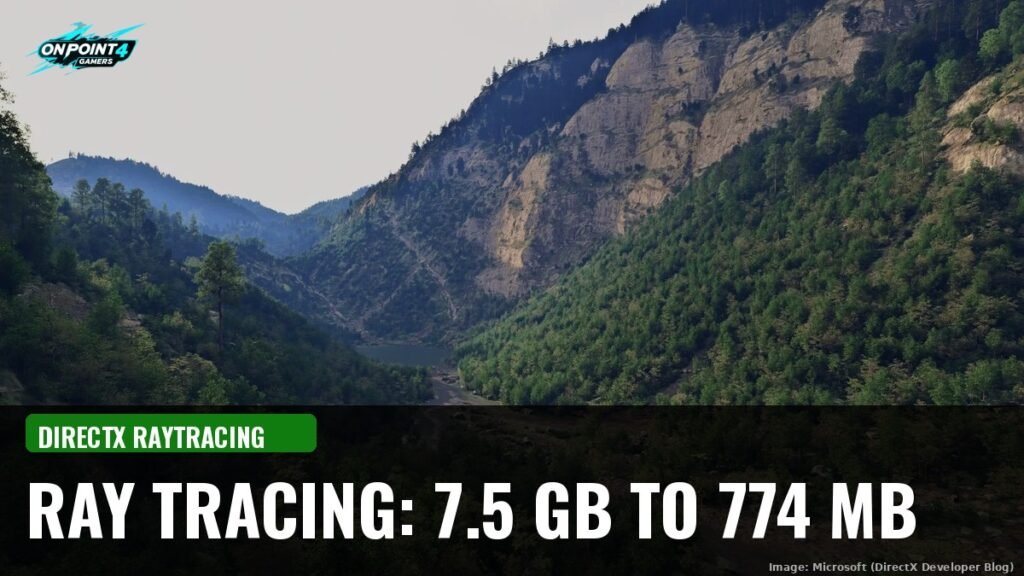
A new DirectX 12 preview brings clustered geometry and partitioned scene updates to Nvidia, AMD and Intel GPUs. In Microsoft's own test, ray tracing memory dropped from 7.5 GB to 774 MB and frame rate jumped from 1.2 to 79 FPS.
Microsoft just dropped what it calls the biggest change to DirectX Raytracing since it launched. In a DirectX Developer Blog post published October 28 and picked up today by PC Gamer, Microsoft engineer Amar Patel wrote: “For DXR this is the most significant update since its debut in 2018.”
The key facts
- What it is: two new DirectX Raytracing features, Clustered Geometry and Partitioned Top-Level Acceleration Structures (PTLAS), plus a GPU-driven API to build and update them. They ship in the Agility SDK 1.722 preview.
- No new hardware needed: Microsoft says the features “don’t require new hardware capabilities beyond existing raytracing support.”
- Supported right now: all Nvidia RTX GPUs, AMD Radeon RX 9000 series, Intel Arc B-Series graphics and Intel Core Ultra 200V and Series 3 processors. Qualcomm is targeting Snapdragon X2 driver support in Q1 or Q2 2027. Support for some older ray tracing GPUs is still to be determined.
- Not in your games yet: it’s a developer preview. It needs the preview SDK, the Shader Model 6.10 preview compiler, a supporting driver and Windows Developer Mode. Microsoft hasn’t given a retail release date.
How it works, in plain words
Ray tracing needs a map of every object in a scene so the GPU knows what each ray hits. Rebuilding that map every frame is expensive, especially when things are moving.
- Clustered Geometry chops models into small reusable chunks of up to 256 triangles and 256 vertices. Instead of rebuilding a whole model when it animates or streams in, the game reuses and recombines the chunks. Microsoft says this can make it practical to ray trace the same full-detail geometry you see on screen, “so ray-traced shadows and reflections match the visible scene.”
- Partitioned TLAS splits the whole world into regions and only updates the parts that changed. In Microsoft’s words, it lets the update cost be “proportional to the amount that changed in a scene as opposed to the entire scene.”
PC Gamer sums it up as bringing tech very similar to Nvidia’s RTX Mega Geometry to every GPU vendor.

The test numbers
Microsoft ran its Clustered Geometry sample on an AMD Radeon RX 9070, comparing a traditional rebuild against the new approach:
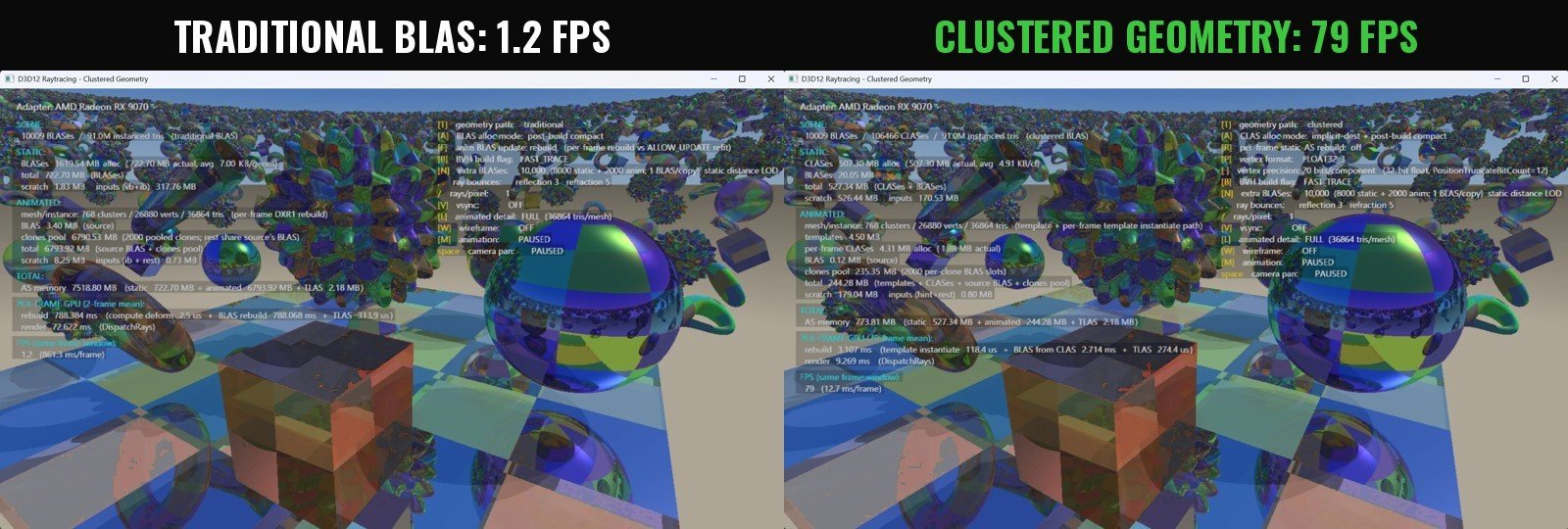
- Frame rate: 1.2 FPS to 79 FPS (about 66x higher)
- Per-frame build time: 788 ms to 3.11 ms
- Ray tracing time per frame: 72.6 ms to 9.27 ms
- Total acceleration structure memory: 7,519 MiB to 774 MiB, which is 89.7% less
- The catch: temporary build memory went way up, from 1.83 MiB to 526 MiB for static objects in the sample.
In a separate falling-dominoes sample built by Nvidia, Partitioned TLAS cut the scene update from 2.88 ms to 0.79 ms per frame, though tracing rays got a little slower.
Microsoft is upfront that these are lab numbers. The blog says in all caps: “DO NOT ASSUME GAMES WILL SEE THIS MAGNITUDE OF WINS, THIS IS JUST A TEST PLAYGROUND.”
Where Gears of War: E-Day comes in
Here’s the part Xbox fans will love. Microsoft’s post says: “Gears of War: E-Day is an early example of a title adopting clustered geometry through NVIDIA’s vendor-specific API, RTX Mega Geometry.” Standardizing it in DirectX, Microsoft says, gives “a common integration path across supporting hardware,” so more future games can use it, no matter whose GPU you run.
What Nvidia, AMD and Intel said
- Nvidia (Martin Stich, Senior Director of Engineering): “These features enable unprecedented levels of animated geometric detail and unlock new algorithms including path tracing of hierarchical LOD streaming solutions found in modern game engines.”
- AMD (Rodney Andre, Corp. VP Software Development): the ability to reuse geometry and update only what changed “can significantly improve scalability for streaming content, level-of-detail transitions, animation, and large open-world experiences.”
- Intel (Matthäus Chajdas, Senior Principal Engineer): the APIs “set the foundation for efficient updates and management of very large and complex scenes, while keeping the memory footprint low.”
Do you turn ray tracing on in your PC games?
Vote and see what other Xbox fans think.
Like having a say? Get OnPoint Weekly or argue it out on Discord.
OnPoint’s take: This is a big W for PC gaming, and it’s Microsoft doing it. Ray tracing has always made you pick between pretty and playable, and VRAM is the wall a lot of cards hit first. Taking the tech Gears of War: E-Day already uses and making it standard across Nvidia, AMD and Intel means more games can go all in on full-detail ray tracing without needing a monster GPU. Pair this with the shader stutter fix Xbox brought to Unreal Engine 5.8 and you can see Microsoft working hard to make Windows the best place to play. It’s a preview for now, so don’t expect your games to change tomorrow, but the direction is exactly right.
Image: Microsoft (DirectX Developer Blog) / OnPoint 4 Gamers graphic
Sources
- DirectX Developer Blog: [[PREVIEW] Raytracing: Clustered Geometry, Partitioned TLAS, Indirect Acceleration Structure Builds](https://devblogs.microsoft.com/directx/clas-ptlas-preview/) (Oct 28, 2026)
- DirectX Developer Blog: DirectX Agility SDK 1.620 and 1.722-preview release blog
- PC Gamer: Ray tracing memory usage could be reduced by up to 90% thanks to ‘most significant’ DirectX update (Nov 2, 2026)
- Notebookcheck: Microsoft DirectX 12 update slashes ray tracing VRAM usage by 90%
- Guru3D: Microsoft previews GPU-driven DirectX ray-tracing scene updates