
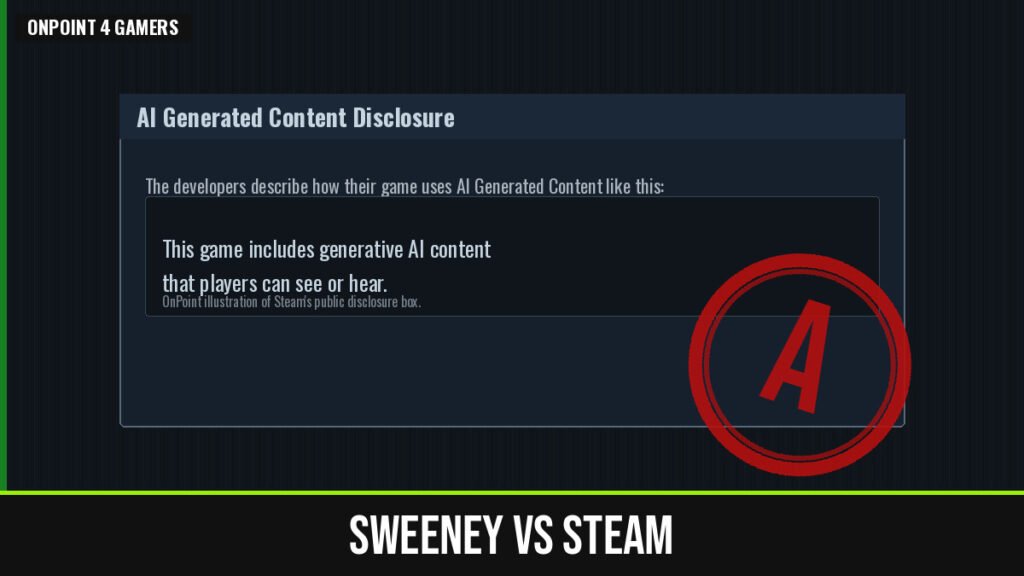
Epic's CEO says Valve's generative AI disclosure is "being used toxically" against developers and wants players to judge games by reviews instead. He's right that a label isn't a verdict. He's wrong that players don't deserve to know.
Tim Sweeney is not letting the Steam AI fight go. In a long exclusive interview with GamesBeat published Friday, the Epic Games boss said the generative AI disclosure Valve requires on Steam has turned into a weapon against the developers who fill it out.
“The AI disclosure has become a scarlet letter, which drives attacks on games not because of their quality, but simply because of the choices of how they were developed,” Sweeney said. He argued the label is “being used toxically here, because it’s absolutely being used by anti-AI advocates to undermine the reputations of developers and the viability of their projects.”
When GamesBeat’s Dean Takahashi played devil’s advocate and suggested Valve just wants players to have the information, Sweeney didn’t budge. “I don’t buy it in the slightest,” he said. “Steam already has a review system that’s very much intended to capture all facets of a game’s quality, scope, entertainment value and so on.”

It’s spicy, it’s very Sweeney, and it comes from the guy who runs the biggest rival to Steam on PC. Keep that last part in mind.
Sweeney’s case
Sweeney’s core point is simple. “You can build good games and bad games without AI. You can build good games and bad games with AI,” he said. “If we were to identify AI as associated with bad games, that’s just unfair to developers who use AI to make good games. It’s a guilt by association pattern that all developers need to push back on.”
He also complained that the existence of a disclosure has become “the primary news story for the launch of several new games, rather than the game itself,” and questioned why the debate treats AI-generated art differently from AI-written code. Any argument about AI, he said, “should be roughly content neutral.”
Then he went way further than most industry bosses will say out loud. Sweeney claimed AI tools are already delivering “often 4X productivity gains” across code, content, testing and bug fixing, and warned that large studios that don’t adopt it “will absolutely be left behind and rendered uneconomical, non-viable compared to their peers.” Epic’s executive vice president of engineering, Marcus Wassmer, backed him up with an example: a couple of engineers “managing a few fleets of agents” pushed out the Unreal Engine 5.9 preview with a new web GPU target in a week and a couple of days. Sweeney pegged that at roughly 20 times faster than doing it by hand. Wassmer agreed for the prototype but said the finished version “might be more like five to 10.”
How we got here
This fight has been building for weeks. Back in October, Sweeney went after Valve on X over the same disclosure, calling it “abhorrent” to force developers “to write a political statement to be used against them by the hate mob they’re helping organize.” Around the same time, he called Steam a “social walled garden,” which we covered alongside Valve admitting Steam has an AI slop problem.
Forcing developers to write a political statement to be used against them by the hate mob they’re helping organize is abhorrent.
, Tim Sweeney (@TimSweeneyEpic) October 23, 2026
Valve’s disclosure has been around since January 2024, and in January 2026 Valve narrowed it to focus on AI-generated content players can actually see or hear, not tools used behind the scenes. It’s also everywhere now. A community analysis found 49.9% of games released on Steam in October 2026 carried the disclosure, mostly smaller releases, as we reported in our Steam AI disclosure story.
Why PC players should still want the label
Here’s where we land. Sweeney is right that a disclosure isn’t a quality score. Plenty of great games will use AI somewhere in the pipeline, and a label alone can’t tell you if a game is fun. Review bombing a game just because the box got ticked isn’t fair to the people who made it.
Tim Sweeney wants Steam's AI label gone. Your call?
Vote and see what other Xbox fans think.
Like having a say? Get OnPoint Weekly or argue it out on Discord.
But “just read the reviews” doesn’t work at launch, when there aren’t any. A pre-order page is exactly when players decide whether to buy, and a one-line note about AI-generated art or music is useful information for anyone who cares about it. And as we reported earlier this month, Steam doesn’t offer a filter to hide those games anyway. All the label does is tell you what’s in the game you’re paying for. That’s not a scarlet letter. That’s an ingredients list.
The developers themselves aren’t sold on Sweeney’s vision either. The latest GDC State of the Game Industry report, which surveyed more than 2,600 industry professionals, found 40% of respondents use generative AI in their jobs, up from 36% last year, but 55% said it’s having a negative effect on the industry, with 35% calling it mixed and just 8% positive, per PC Gamer. That’s not a “hate mob.” That’s the industry itself.
The fair middle ground is a clearer label that says exactly what AI was used for, not no label at all. If Sweeney thinks AI-made games can be great, the best way to prove it is to ship great ones and let players see the label and buy them anyway. It is what it is.
Where do you stand on Steam’s AI label? Vote below.
Image: OnPoint 4 Gamers illustration of Steam’s AI disclosure box
Sources found below.