Ninja Theory has created the new benchmark of what a game can be.
Disclosure: Xbox and Ninja Theory provided the game for review.
This is next gen. This is what we’ve been waiting on. There has never been a game that compares to what Ninja Theory has accomplished with Senua’s Saga: Hellblade II. There’s no uncanny valley here. They’ve set a new benchmark for real-time graphics in gaming, period. It’s a technological achievement that will eventually be surpassed, but my mind can’t fathom what that would even look like.
Watch the video review
 Senua’s Saga: Hellblade II Review: A New Benchmark for Gaming
Want to play it? Grab it on the Xbox Store or see Where to buy.
Story
I want to keep this as spoiler-free as possible, because it wouldn’t be fair to rob you of the experience. I loved it. Ninja Theory tells the story through the visuals and the gameplay as much as through dialogue, and you can tell every decision they made served the story. The characters you meet are multi-dimensional, each with depth, purpose and interesting personalities, and they all fit perfectly into moving Senua’s story forward. Because as great as those characters are, this is 100% Senua’s story.
Gameplay
Like everything else here, the gameplay serves the story. I break it into three parts.
First, story and exploration. You walk or run between areas, alone or with companions, or explore a town, and the graphics, animation, audio and story combine to pull you in. The controls are smooth and responsive, and since there’s no HUD, you really feel like you’re exploring. The game is designed so you engage with the world naturally and logically, and the whispers from the Furies clue you in. At one point it was dark, I wished I could grab a torch I saw, and sure enough, I pressed A and she grabbed it.
Second, puzzles. I’m not a huge puzzle guy, but these were fun and challenging without being mind-numbing. The symbol puzzles are done way better than in the first Hellblade and are much more forgiving. The other two types are interesting and challenging, and none of them overstay their welcome.
Third, combat, and it’s a huge upgrade over the first game. We went back and watched some fights from the original, and there’s no comparison. Every battle feels like it could be her last. It’s one-on-one combat with two attack types, a dodge and a parry. Heavy attacks break enemy blocks and shields, and you can cancel any attack with a dodge or parry, so you’re always in control. Later, a mirror Senua carries on her hip unlocks unblockable combos once a meter fills, and I always saved it for the bigger, tougher enemies. Battles are one-on-one but can include multiple enemies and allies, and the game brings them in so masterfully that it feels like a much bigger battle while staying manageable. I looked forward to every encounter.
Visuals
Every visual aspect is cranked up to 11. The texture work is unreal: clothing, buildings, even the smallest pebbles look like you could reach out and grab them. Ninja Theory physically made the costumes in the real world and scanned them into the game, and they’re so confident in the result that they do tons of close-ups. The skin, the eyes and especially the hair look real, with no clipping and no weird physics. Having no HUD by default really enhances the look and the immersion.
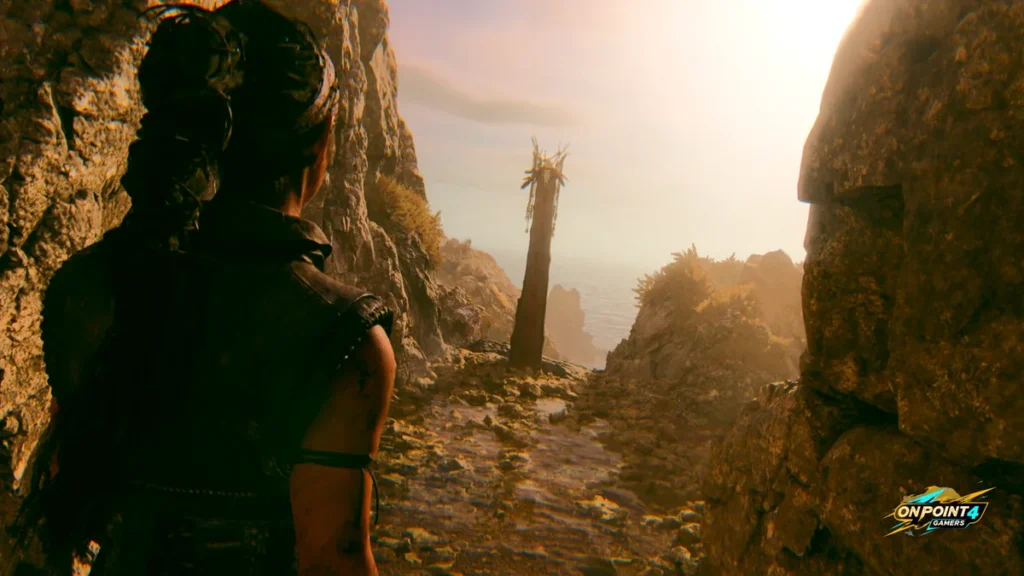
The environments are a highlight. Weather, fog, particles, smoke and lighting combine into a visual feast. The team scanned real Icelandic landscapes using photogrammetry, and it’s the most realistic-looking world I’ve ever seen in a game. Breathtaking in a screenshot, unbelievable in motion. The biomes, from snowy mountaintops to mythical caves to foggy forest, are varied, and there’s no filler: every environment serves the narrative.
The real-time animation is as close to perfect as possible. I couldn’t find a perceivable imperfection. You can feel how tired, afraid, desperate, determined and doubtful Senua is, without words, just from her body and face. Movement is buttery smooth, even running backwards. And visually, I’ve never played a game that felt more visceral or violent in real time: the pain in her face when she’s hit, the rage behind every swing, detailed and intimidating enemies, and a wide variety of finishers that transition you to your next enemy. Hellblade II is a technical masterpiece.
Sound
The audio is superb, from the epic combat soundtrack to each wave crashing against the rocks to some of the best voice work I’ve heard in a game. The Furies, the voices in Senua’s head, are excellent. At times I felt like they were saying my thoughts out loud, and it blew my mind to learn their performances were largely unscripted. They don’t freak me out; they feel like an extension of what Senua is thinking and feeling, and hearing her fears, doubts and positive affirmations kept me engaged the whole time.
Verdict
This is a serious game, so “fun” isn’t about laughing. But like a great movie or song, Hellblade II moves you, and I enjoyed every moment of it, from the slower story moments to the puzzles to the intense combat. With this game, Ninja Theory has reached superstar status. Ninja Theory has created the new benchmark of what a game can be. I didn’t want to stop from the moment I turned it on until I rolled credits. It’s a masterpiece I’ll never forget, and a rare game I can see myself playing again and again over the years. It’s on Game Pass, and you need to play it.
Image: Ninja Theory / Xbox Game Studios (official Steam screenshot)
More on OnPoint: Gears of War: E-Day Review: The Coalition Built a Showpiece With a Heart and Forza Horizon 6 Review: The Best Open-World Racer Ever Made.
The verdict: Masterpiece
Ninja Theory has created the new benchmark of what a game can be.
Pros
- Benchmark-setting graphics and animation
- Visceral, much-improved combat
- Masterful, spoiler-worthy story
- Superb audio and Furies performances
- No HUD and no filler
Platform played: Xbox Series X|S and PC