
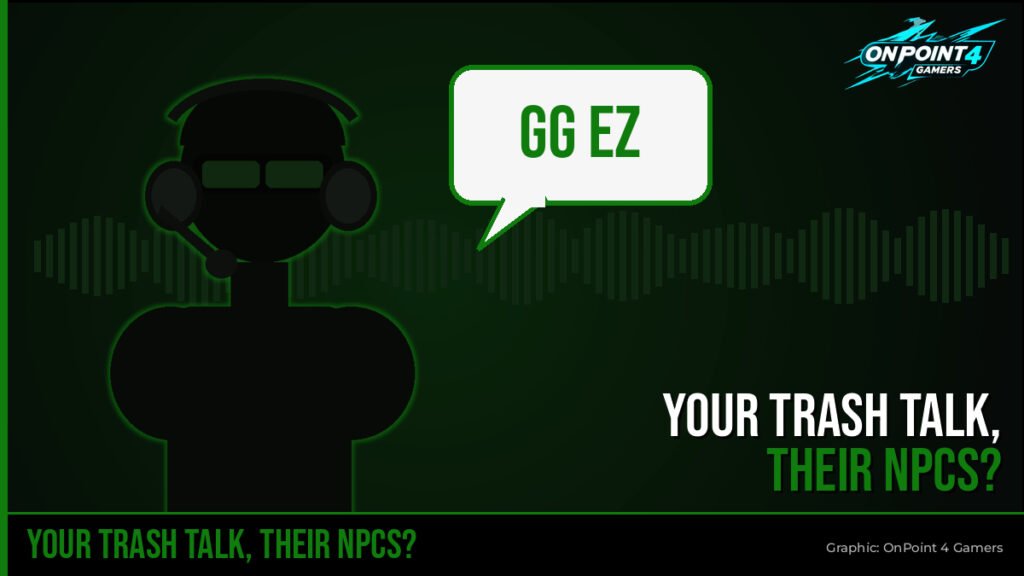
A newly published Activision patent application describes recording players' voice chat around kills, deaths and wins, then teaching computer-controlled characters to react the same way. It could make lobbies feel alive. It also puts your private party chat on the table.
That shout you let out after a cross-map snipe could one day come out of an NPC’s mouth. Activision, the Xbox-owned publisher behind Call of Duty, has a patent application on file that describes listening to players’ voice chat, matching their reactions to big in-game moments, and training computer-controlled characters to gloat, groan and celebrate the same way real people do.
The filing, titled “Methods and Systems for Applying Machine Learning to Generate Gameplay Audio,” was published by the U.S. Patent and Trademark Office on November 12 as US 2026/0355629 A1. Activision filed this version on July 16, 2026, as a continuation of an application it first filed in December 2023, and Patentlyze lists it as still waiting on an examiner. Insider Gaming pushed it into the spotlight this morning.
How it works
The abstract spells out the goal plainly: generate “audio reactions for a virtual game character that closely resembles reactions of a human player in a multiplayer video game environment.” The game watches for moments developers flag ahead of time, like a kill, getting killed, a victory or a loss. When one happens, the system grabs the voice chat from just before and just after it. The filing gives 10 seconds in each direction as one example. Each clip gets paired with the moment that caused it, and those pairs train a neural network to learn what a believable reaction sounds like, emotion included.
Here’s the part that’s getting people talking. The claims describe pulling that audio from a voice app running separately from the game, and the filing names Discord as an example. Insider Gaming notes TeamSpeak is listed too. So this isn’t only about in-game party chat. It’s built to listen to the app many of us treat as the private hangout with the homies.
The system also keeps a profile on each player, built from things like language, location and engagement, and uses it to pick which reactions you hear. A Spanish-speaking player would get Spanish-language reactions, for example. One passage describes tuning that profile with “analytics of spend/engagement,” which is the kind of phrase that should make any player raise an eyebrow. Abusive or offensive audio is supposed to be filtered out before anything plays back, and player feedback can retrain what gets chosen. The filing even pitches it as a way to give a voice to players who join without a mic.
Cool idea, but consent has to come first
Let’s be fair to the idea, because it’s a genuinely fun one. Every Call of Duty player knows the bots in practice lobbies and campaign firefights run through the same handful of canned lines. NPCs that pop off like a real squad after a clutch play would make those modes feel a lot less robotic, and a filter tuned to your language is a smart touch.
But the cost is your voice, and the filing doesn’t describe asking permission or telling players their reactions could feed game audio. That’s the line Activision has to get right if this ever ships. A party chat on Discord is not a Call of Duty lobby, and nobody signed up to be a voice actor by talking trash with their friends.
Would you let your voice chat train NPC trash talk?
Vote and see what other Xbox fans think.
Like having a say? Get OnPoint Weekly or argue it out on Discord.
Activision already listens to in-game chat for a different reason. Since 2023, Call of Duty has used Modulate’s ToxMod to flag hate speech and harassment in voice chat, a system that rolled out worldwide outside Asia with Modern Warfare III. Moderating toxicity is one thing. Turning reactions into training material is a much bigger ask, and the moderation problem gets harder too: one slur that slips past the filter and an NPC repeats it to a stranger.
Our take: Activision is part of the Xbox family now, and Xbox has spent years selling itself as the platform that puts players first. If this tech ever reaches a game, it should be clearly labeled, opt-in, and easy to turn off. Do that and trash-talking NPCs could be a real W for Call of Duty. Skip it and it’s a privacy fight nobody at Xbox needs.
For now, it’s a patent application, not a feature. Companies file plenty of ideas that never ship, and no Activision game has been announced with anything like this.
Sources found below.