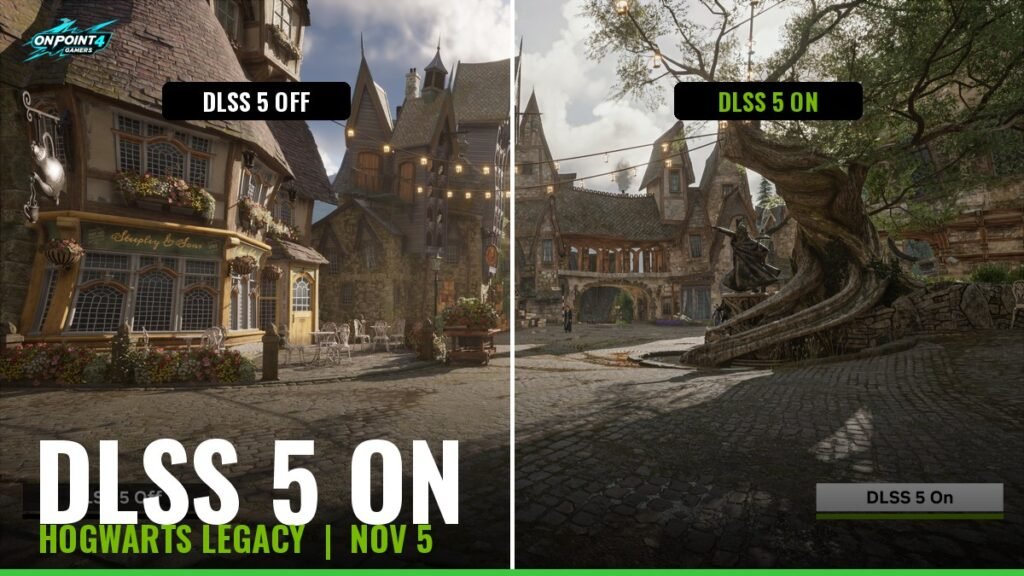
NVIDIA just dated its next wave of DLSS 5 games: Hogwarts Legacy on Thursday, November 5, War Thunder in mid-November, and Where Winds Meet on November 23. All three run on any GeForce RTX 50 Series card, not just a monster rig.
NVIDIA announced the lineup this morning (9:01 AM ET, November 3) on X and in a full GeForce news post. DLSS 5 is NVIDIA’s “3D-Guided Neural Rendering” tech. Instead of just boosting frame rate, it works as the last step of the rendering pipeline and adds more lifelike lighting and material detail on top of what the game engine already drew, with the developers deciding how much and where.
The dates
- Hogwarts Legacy: Thursday, November 5, via a game update.
- War Thunder: mid-November, as part of the Eagle’s Shadow major update.
- Where Winds Meet: November 23.
- New Game Ready Driver: November 4 in the NVIDIA app, which NVIDIA says you need for DLSS 5 in these games.
What you need to know
Who can use it
- Any GeForce RTX 50 Series desktop GPU or laptop.
- RTX Spark PCs.
- GeForce NOW Ultimate members, through the cloud.
That’s a big change from where this started. NVIDIA says that when it first showed DLSS 5 in March, it ran on two RTX 5090s. Seven months later it runs on a single card, which NVIDIA calls a 10X performance gain.
How to turn it on in Hogwarts Legacy
- Update the NVIDIA driver (the new Game Ready Driver lands November 4).
- Download the Hogwarts Legacy update on November 5.
- Go to the in-game options and turn on “Neural Rendering.”
For players it’s a simple on or off toggle. NVIDIA also recommends turning on DLSS Super Resolution under “Upscale Type,” DLSS Multi Frame Generation under “Frame Generation,” NVIDIA Reflex under “Low Latency Mode,” and DLSS Ray Reconstruction if you’re using ray tracing.
What it actually changes
In Hogwarts Legacy, NVIDIA says the Neural Rendering option enhances environment detail and shadows, improves character texture detail, refines shading and lighting, and makes reflections more vibrant. Avalanche used DLSS 5’s controls to push the environment boost harder while keeping characters looking like themselves. NVIDIA’s Hogsmeade comparison shows mossy roofs with more depth, flower boxes with local shadows, and richer contact shadows inside stone archways.
In War Thunder, Gaijin says it got better highlights, sharper shadows and more micro-contrast across air, ground and naval fights. In Where Winds Meet, NVIDIA says Everstone Studio and NetEase “maximized DLSS 5’s settings,” and that players had been asking for it.
The performance numbers (NVIDIA’s own benchmarks)
- Hogwarts Legacy, 4K max settings with ray tracing, DLSS 5 on: up to 300 fps on an RTX 5090, using 6X Multi Frame Generation, Ray Reconstruction and Reflex.
- Hogwarts Legacy, 1440p: up to 370 fps, per NVIDIA.
- War Thunder, 4K ground battle benchmark with DLSS 5: up to 400 fps.
- War Thunder, 1440p Ultra preset with path tracing: up to 550 fps.
- War Thunder on an RTX 5090 Laptop GPU, 1440p High preset with path tracing: up to 300 fps.
These are NVIDIA’s numbers with frame generation on, not independent tests.
The new model
All three games launch with NVIDIA’s October 2026 Neural Rendering model. NVIDIA says it’s 24% smaller (about 118 million parameters), uses 20% less VRAM at 4K, and runs 2X faster than the previous version.
Also in the post: Modern Warfare 4 Season 1
Call of Duty: Modern Warfare 4 Season 1 launches November 6. On PC, DLSS Super Resolution works in all modes, RTX 40 Series cards get DLSS Frame Generation, and RTX 50 Series cards get DLSS Dynamic Multi Frame Generation up to 6X. NVIDIA Reflex is available on all GeForce RTX cards.
What the developers said
“The team at Avalanche Software worked closely with NVIDIA to add DLSS 5 Neural Rendering technology into Hogwarts Legacy for PC to ensure the best visual results while maintaining our artistic intent,” said Jose Villeta, Director of Software Engineering at Avalanche Software. “This allowed us to iterate and tune environments, tone and skin structural parameters in a manner that keeps the game true to the original vision. We’re excited for players to jump back into the game and experience it in a new way.”
Context
DLSS 5 is coming to Hogwarts Legacy. You turning it on?
Vote and see what other Xbox fans think.
Like having a say? Get OnPoint Weekly or argue it out on Discord.
DLSS 5 isn’t a straight upscaler like the DLSS versions most PC players know. NVIDIA pitches it as a way for studios to add detail their “compute and VRAM budgets would never let them model and render explicitly.” Developers can pick different models for different scenes, dial in “Structure Intensity” and “Tone Intensity,” and mask off what gets enhanced, like boosting the world while holding back on faces. Where Winds Meet is a big get here: NVIDIA says it has more than 100 million players worldwide and peaked above 250,000 concurrent players on Steam.
OnPoint’s take: This is the part people are missing: DLSS 5 went from needing two RTX 5090s to running on any RTX 50 Series card in seven months. That’s the real story. Graphics are a big deal around here, and if a game goes for realistic, go all in. Hogwarts Legacy getting a free visual glow-up this Thursday is a W for PC players who want a reason to jump back into the wizarding world. The question we still want answered is how it looks on a mid-range RTX 50 card, not a 5090 with 6X frame generation. We’ll be checking it out.
Image: NVIDIA, OnPoint 4 Gamers graphic