
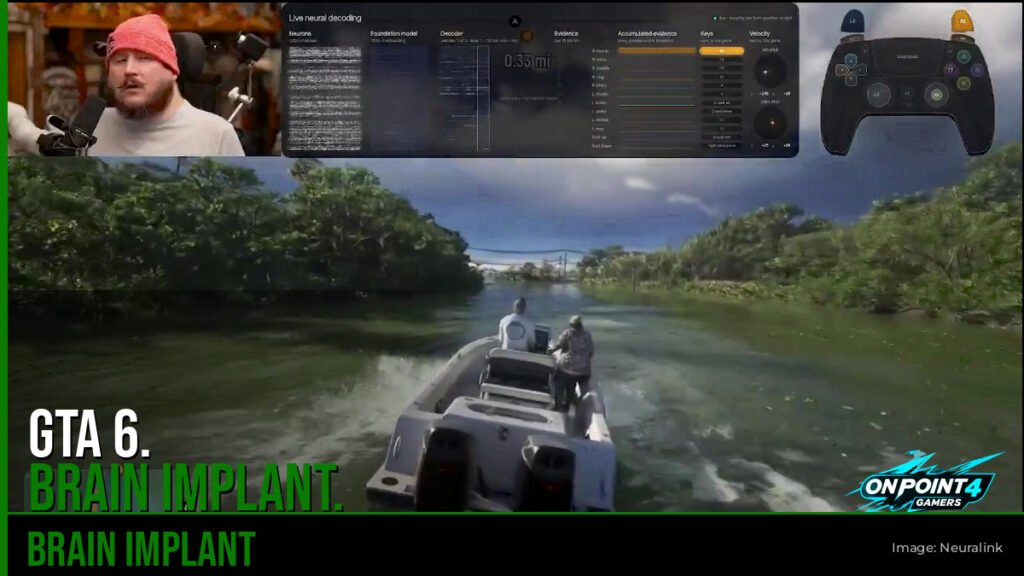
Neuralink posted a two-minute video Friday afternoon of an unnamed clinical trial participant steering a boat, throwing punches, flying a plane and driving in Grand Theft Auto VI. The clip's overlay maps his neural signals to a DualSense controller. The company says the implant is still investigational.
One day after Grand Theft Auto VI launched, Neuralink posted a two-minute video of a clinical trial participant playing it with a brain implant. The official caption said only, “Playing GTA VI with a Neuralink.” The post went up Friday at 4:27 PM ET and took off fast.
Neuralink did not name the player, and its caption did not name a console. In the clip, the participant talks through what he’s doing on a webcam in the corner, while a dashboard labeled “Live neural decoding” sits next to a DualSense graphic that lights up with each input. The in-game prompts use PlayStation buttons, including one that says, “Hold □ or ○ to use the plane rudder while flying or on the water.”
Playing GTA VI with a Neuralink pic.twitter.com/ViFjXK9OSV
, Neuralink (@neuralink) November 20, 2026

A few minutes later, Robert Dale Smith, whose X bio lists BCI Applications at Neuralink, wrote that he had been “working on enabling Neuralink to control any device.. including PlayStation 5 to play GTA VI at launch!” He credited JoypadOS, firmware he maintains for controller adapters. That is his post, not Neuralink’s caption.
What’s actually in the video
The footage is a highlight reel, not a full session. The participant threads a speedboat under a bridge in a tight canal and says, “Ooh, threaded the needle, look at that.” The clip then jumps to a gunfight with the objective “Save Donnie,” and into a close-quarters fight where he explains the mapping. “Right now I’m just like tapping my ring finger. Each ring finger. Bam, look at that. That’s what a ring finger can do in GTA.” He says the team later “added my feet in, or at least my foot.”
He gets a seaplane up off the water and explains the analog control: “To pull the nose of the airplane up I essentially have to slide my right hand forward. So it’s more like, it’s almost like the mouse motion.” When it lifts, he repeats, “We did it, we did it.” The video ends on a night drive in a pickup, where he notes that “decreasing some speeds would help.”
He also talks about life before the implant. “Before the old chip and surgery, I was using a mouth stick and an iPad. Like I was essentially like a bird just pecking at an iPad.” That setup, he said, “made your jaw sore, made like everything sore.” After the implant, the change was immediate: “Controlling a computer is like, boom, portal to the world. Like you immediately just get your portal to the world back.”
What's your honest reaction to the Neuralink GTA 6 clip?
Vote and see what other Xbox fans think.
Like having a say? Get OnPoint Weekly or argue it out on Discord.
What Neuralink is actually claiming
In a reply posted one minute later, Neuralink said its devices “are investigational and have not been approved by the FDA or other regulatory authorities,” and that the clip features a voluntary trial participant sharing a personal experience “which may not reflect all participants or future outcomes.”
This is one volunteer, in a short edited demo, using decoded brain signals as controller inputs in a game that just came out. It does not tell us how long he played, how every participant would do, or that the device is ready for anyone else.
The timing is still wild. Take-Two just called GTA 6 the biggest entertainment launch in history, and a day later the world is watching someone play it by thinking about his fingers and his foot. That is a real access story, not a gimmick. The same game is also out on Xbox Series X|S. If this kind of control can be pointed at a DualSense, the next question for us is simple: when can players who need it do the same thing on Xbox?
Image: Neuralink
Sources found below.