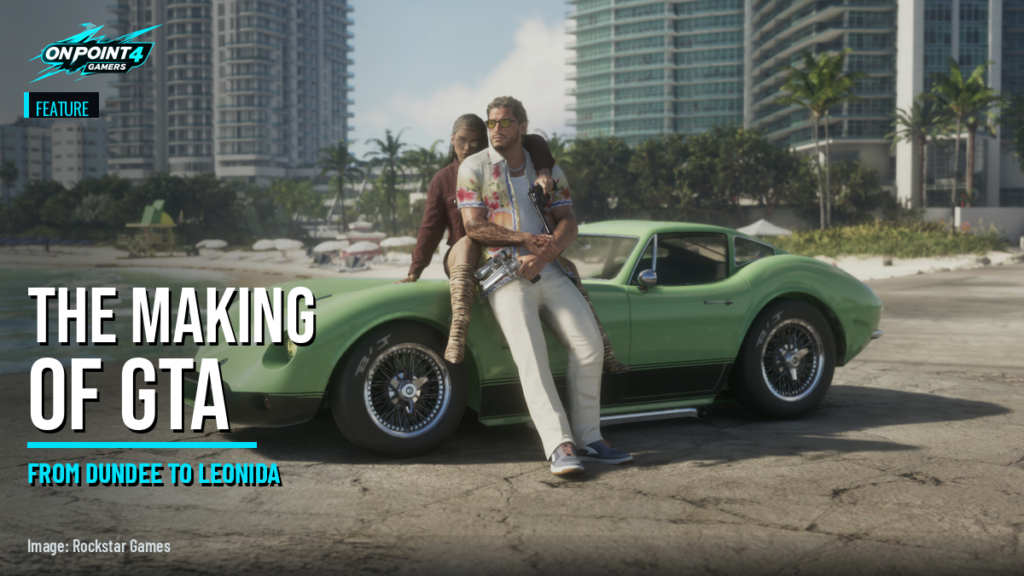
Grand Theft Auto did not begin as a billion-dollar destiny. It began as a troubled cops-and-robbers prototype in Scotland, a dinosaur tech demo that somehow became a car, and a franchise that kept inventing the open world every time the industry thought it had caught up. Here is the story, told with the people who built it, as Leonida finally arrives.
Feature · Making Of
Grand Theft Auto VI launches on Thursday, November 19, 2026. Rockstar put that date in writing on its Newswire after years of silence, trailers, and delays that turned waiting into a lifestyle. This piece is not a spoiler hunt, and it is not a review, even though reviews are expected this morning, one day before launch. It is the long road that made the wait feel inevitable: Dundee to Edinburgh to New York to every living room that ever heard a fake radio host roast American culture while a stolen car screamed into a tunnel.
OnPoint has covered this franchise like it matters, because it does. GTA is not just a crime game. It is the argument that a video game can feel like a city that was already running when you showed up. The people who made that argument said a lot of it out loud. Those voices belong here.
Dundee, Race’n’Chase, and the dinosaur that became a carjacker
Every great GTA story starts with somebody being unreasonable in Scotland.
DMA Design grew out of Dundee’s computer-club energy, the same scene that gave the world Lemmings after Dave Jones watched Mike Dailly’s looping Deluxe Paint animation of a little character walking into a turret. Jones later told GamesBeat the idea hit him like a switch: what if you could divert that walker so he would not stroll into the cannon? Lemmings made DMA famous. Grand Theft Auto made DMA immortal, and it almost did not exist.
The franchise did not start as a manifesto about crime. It started as a tech experiment. Colin Macdonald, who joined DMA shortly before the first GTA shipped, told the BBC that founding programmer Mike Dailly was testing how buildings could look in a top-down 3D perspective. The prototype put a dinosaur in a city that moved with a little bit of depth. Cars got added to make the city feel alive. Then somebody tried driving one of the cars instead of stomping buildings as a dinosaur. Suddenly it was a driving game.
They called it Race’n’Chase for a good while. The original fantasy was cops and robbers. Brian Baglow, who worked on the design side in that era, later recalled on BBC Alba that playing the policeman was not fun: zoom around, knock into the wrong things, and the game had to punish you for behaving like a menace in a badge. After months of arguments and team meetings, they flipped the fantasy. You played the crook. The name became Grand Theft Auto.
Even then, confidence was low. Macdonald told the BBC that in mid-development, an informal staff survey asked which of seven titles in the building would do best and which would flop. The one voted most likely not to succeed was Grand Theft Auto. It was buggy. Direction felt mushy. You could not play it long without a crash. Grassroots belief was thin.
Then, late, the pieces that matter showed up: skid marks, shadows, radio, the feeling of a city with noise. The team started playing it at lunch. Macdonald called that a rare signal. After years on a project, most people never want to see it again in their free time. GTA launched on November 28, 1997 after roughly three and a half years of development. The side project nobody trusted had a pulse.

Top-down chaos, and the first version of the argument
The early games were rude on purpose. Tiny cities. Wanted stars. Radio chatter. The joke and the dare lived in the same pixel: what if the fun was being the problem?
That dare is why the franchise survived its own growing pains. GTA 2 pushed a more futuristic vibe that the audience never hugged the way it hugged the first game’s contemporary chaos. Macdonald later said the contemporary vehicles and cities were what resonated, and most later GTAs returned to that present-tense America. The top-down era proved the fantasy. The 3D era would prove the medium.
By the end of the 1990s, Take-Two had formed Rockstar and then bought DMA Design, the Dundee studio that would become Rockstar North. DMA’s Dundee chapter closed soon after. A satellite studio in Edinburgh, staffed by people who had just shipped Space Station Silicon Valley and Body Harvest, became the next chapter. They were not handed a destiny document. They were handed silence.
Edinburgh starts GTA III before New York says yes
Obbe Vermeij, technical director on GTA III through GTA IV, has told this origin without romance. After Silicon Valley wrapped, there was no next project lined up. People made little prototypes. Vermeij worked on a sailing game and a ball-rolling experiment. Leslie Benzies and Aaron Garbut tried a Godzilla idea first. Then they started building GTA in 3D.
Leslie Benzies and Aaron Garbut actually started work on GTA III then. Later the rest of the team joined. This was before it was even approved by New York.
Obbe Vermeij, GTA BOOM
That sentence should be engraved somewhere in every game-design school. The open-world revolution began as unofficial studio work, inside a team that had just finished something else, before New York had even signed off.
Vermeij has been just as blunt about who drove the day-to-day: Edinburgh made most of the gameplay calls. Sam Houser handled a lot of the New York business and producer energy. Dan Houser owned more of the writing and vibe as the series grew. “Sam and Dan were really good at the vibe stuff,” Vermeij said. New York picked location and tone. Scotland built the city you could steal.
Dan Houser later admitted how naive the original pitch sounded. Take GTA, fix what they did not like, make it 3D, done. “Which was probably the most naive idea we’ve ever had,” he told GameSpot on the game’s tenth anniversary. “Something we’ve learned over the years is that the ideas aren’t the difficult bit; the difficult bit is the implementation.”
Liberty City, an E3 shrug, and the night the medium changed
GTA III launched on PlayStation 2 in October 2001 into a country still raw from September 11. Sam Houser told the BBC that the attacks forced edits. Cop cars that felt too close to NYPD colors got changed. Audio that suddenly felt too sharp got cut. “Suddenly some of those jokes seemed a little less funny,” he said.
The team still believed. Outsiders mostly did not.
Dan Houser remembered E3 2001 as a cold shower. Rockstar thought it had something magical: 3D, open, expansive, cinematic, story-driven, unlike anything on the show floor. The floor shrugged. “We went to E3 and everyone was obsessed by State of Emergency, and no one gave a crap really about GTA III,” he told GameSpot.
Vermeij lived the same dissonance from the code side. During development the game crashed constantly. Frame rate hurt. Programmers rarely played clean start-to-finish builds. Only months out, with music and sound and story glued in, did it feel special. Even then, early sales were good, not mythical. The myth arrived later, when players kept coming back and the industry realized a city could be a genre.
Dan Houser’s best explanation of why it hooked people still holds. It was not scripted theater pretending to be free. It was a low-rent simulation you could push. “It was a simulation that you could prod and push and see what happened,” he told Lex Fridman. The other half of the magic was quieter: if you did nothing, the world still seemed to exist. Listen to the radio. Look at a billboard. Be a digital tourist in a place that felt like it was already running.
That is the GTA argument in one breath. Freedom is not a menu. Freedom is a city that pushes back.
Houser also refused the lazy framing that GTA III was “about violence.” “The key idea of the game was that it wasn’t about violence; it was about freedom,” he told GameSpot. Do good, do bad, drive and listen to music, or go full sociopath and get punished for it. The satire was slower than the headlines. America, as Houser put it, “viewed only through movies and advertising.”
Vermeij’s homemade quality rating for the early 3D games is almost insultingly humble, and somehow perfect: everything felt like an eight out of ten. “But if you throw it all together, magic just happens.”
Vice City neon, San Andreas excess, and the year that almost broke them
Vice City was supposed to be smaller. Vermeij has said it was Rockstar New York’s idea to set the game in 1980s Miami, and that it was originally supposed to be a mission pack for GTA III. Instead, in roughly a year (with programmers also shipping the PC port of III), Scotland and New York turned a reskin into a new religion. Neon went in. Vermeij made the weather forever sunny. The music did the rest.
“That would have to be Vice City, I think,” Vermeij said when GamesHub asked which GTA he enjoyed working on most. The atmosphere of III was special because they were inventing the franchise’s 3D identity. Vice was magical because the world changed personality overnight.
San Andreas was the opposite problem. After the one-year madness of Vice, they planned two years and then refused to say no. Stealth. Skydiving. Articulated lorries. A flight back to Liberty City. Vermeij later called it a little messy and a little janky, with a charm that came from saying yes too often. GTA IV would course-correct hard the other way.
Through all of it, the radio stayed sacred. Lazlow Jones, the voice of Chatterbox and so much of the franchise’s media satire, met the Rockstar crew after a chance surfing conversation, then ended up in Dan Houser’s apartment with anchovy pizza and Diet Cokes, typing while Houser threw jokes from a couch. “Dan said, ‘I want to make fun of American radio,’” Lazlow told Shortlist. “And I go, well, here’s the things that you should do, because I’ve worked at some pretty ridiculous American radio stations.”
That beach chat became a two-decade writing partnership. GTA without radio is just traffic.
GTA IV, Hot Coffee scars, and a darker immigrant opera
GTA IV arrived in 2008 as the HD reboot of the fantasy. Vermeij said the map shrank on purpose after San Andreas sprawled. Realism went up. Animations got heavier. Niko Bellic became the most morally complicated protagonist the series had risked. Houser has said the scripts for IV and V stacked into towers of pages once you counted every pedestrian line that sold the illusion of a living city.
The company was also under political and legal fire from the Hot Coffee scandal around that era. Houser later told Fridman that GTA IV felt especially pressured because the company had nearly imploded more than once. The game still shipped as an operatic immigrant story in a version of New York that felt colder and more adult than the neon that came before it.
Vermeij was honest about the trade. He loved Niko. He missed the wild mission variety of the PS2 games. “I felt we lost a little bit too much of that gameplay in GTA IV,” he told GamesHub. A lot of players felt the opposite, and that split is part of why the franchise stayed alive. Every GTA argues with the last one.
Three days, one billion dollars, and a second game that never ended
September 17, 2013. Grand Theft Auto V lands. Three days later, Take-Two announced that worldwide retail sales had already topped $1 billion, calling it the fastest any entertainment property, games or films, had hit that mark. Chairman and CEO Strauss Zelnick called Grand Theft Auto “a cultural phenomenon” and said Rockstar was still redefining what interactive entertainment could be.
That was not the end of the story. It was the beginning of a second product living inside the first. Grand Theft Auto Online launched free with every copy of V and turned a single-player event into a decade-long economy. Take-Two later reported that GTA V had sold-in more than 230 million units worldwide, a lifetime figure that still moves because Online never really left. The wait for VI has been a commercial event of its own: OnPoint has been tracking the pre-order surge as that second life of V finally hands the keys over.
Houser’s creative read on why the excitement never cooled is the cleanest one in the archive. The games do not come out often, and Rockstar kept innovating inside the same crime fantasy so each entry felt familiar and new at once. “People have very strong feelings, ‘I like this one.’ ‘I didn’t like that one as much,’ because they are pretty different,” he told Fridman. You know it will be Grand Theft Auto. You do not know what kind of Grand Theft Auto until you are in it.
Vermeij, watching from outside years later, put the Online reality without bitterness. Prefer single-player all you want. A commercial company goes where the money is, and Online made “ridiculous money.” The trilogy-plus-IV era he worked on took about as long, combined, as the making of VI. Quality expectations exploded. So did budgets. So did patience. Rockstar has since said it could have shipped something faster, a “GTA 5.5,” and chose the big swing instead.
The long wait, and Leonida on the calendar
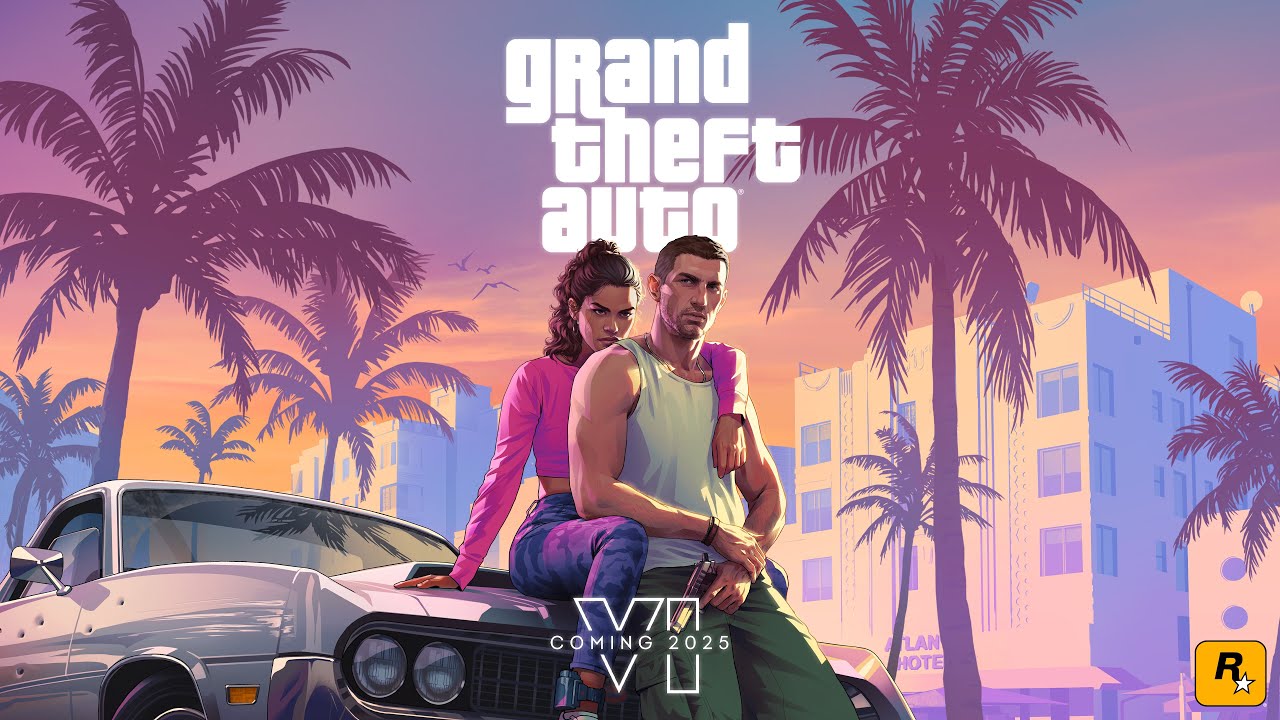
Rockstar announced Grand Theft Auto VI with Trailer 1 on December 5, 2023, pointing at a 2025 window that later moved. On May 2, 2025, Rockstar said the game was coming May 26, 2026. On November 6, 2025, Rockstar moved it again: Thursday, November 19, 2026. The Newswire note apologized for adding time to an already long wait and framed the extra months as polish. Pre-load details followed in 2026. Launch trailers and galleries filled the final stretch. The date is no longer a rumor. It is a Thursday. The game already has a Game of the Year nomination at The Game Awards before anyone can buy it. Reviews landed this morning, and our full review roundup with the scores is live.
 The Making of GTA: From a Dundee Side Project to the Longest Wait in Gaming
Vermeij already likes the setting for what it is. “It’s so over the top, the violence, the behavior, the wildlife. Everything about it just shouts GTA,” he said of returning to a Miami-inspired world. Houser, who has said he did not write VI after leaving Rockstar, still framed the city’s usefulness the way Rockstar always has: Miami, New York, Los Angeles keep working because they are melting pots of gloss and underbelly, immigrant energy and grotesque wealth. The franchise is Americana as spectacle. Leonida is the next stage for that argument.
This is where OnPoint lands the plane.
GTA did not become the biggest entertainment machine on Earth because it was careful. It became that machine because stubborn people in Dundee flipped a cops game into a crime fantasy, because Edinburgh started a 3D sequel before New York approved it, because a surfing conversation turned American radio into a weaponized comedy engine, because a team that got shrugged at E3 shipped a city that taught the whole industry what “open world” was supposed to feel like, and because every sequel after that was willing to argue with the last one instead of photocopying it.
November 19 is not just a product drop. It is the next chapter of a Scottish accident that became global culture. One day before that date, remember where it started: a dinosaur demo, a lunchtime addiction inside a skeptical studio, and a simple idea that still has not been beaten.
Build a world that feels like it was already running. Then let the player decide what kind of person they are going to be inside it.
Leonida is waiting. The people who built this fantasy already told us how it works. Now Rockstar has to prove the wait was worth the legend.
See you in Vice City. Again.
Image: Rockstar Games
Sources found below.